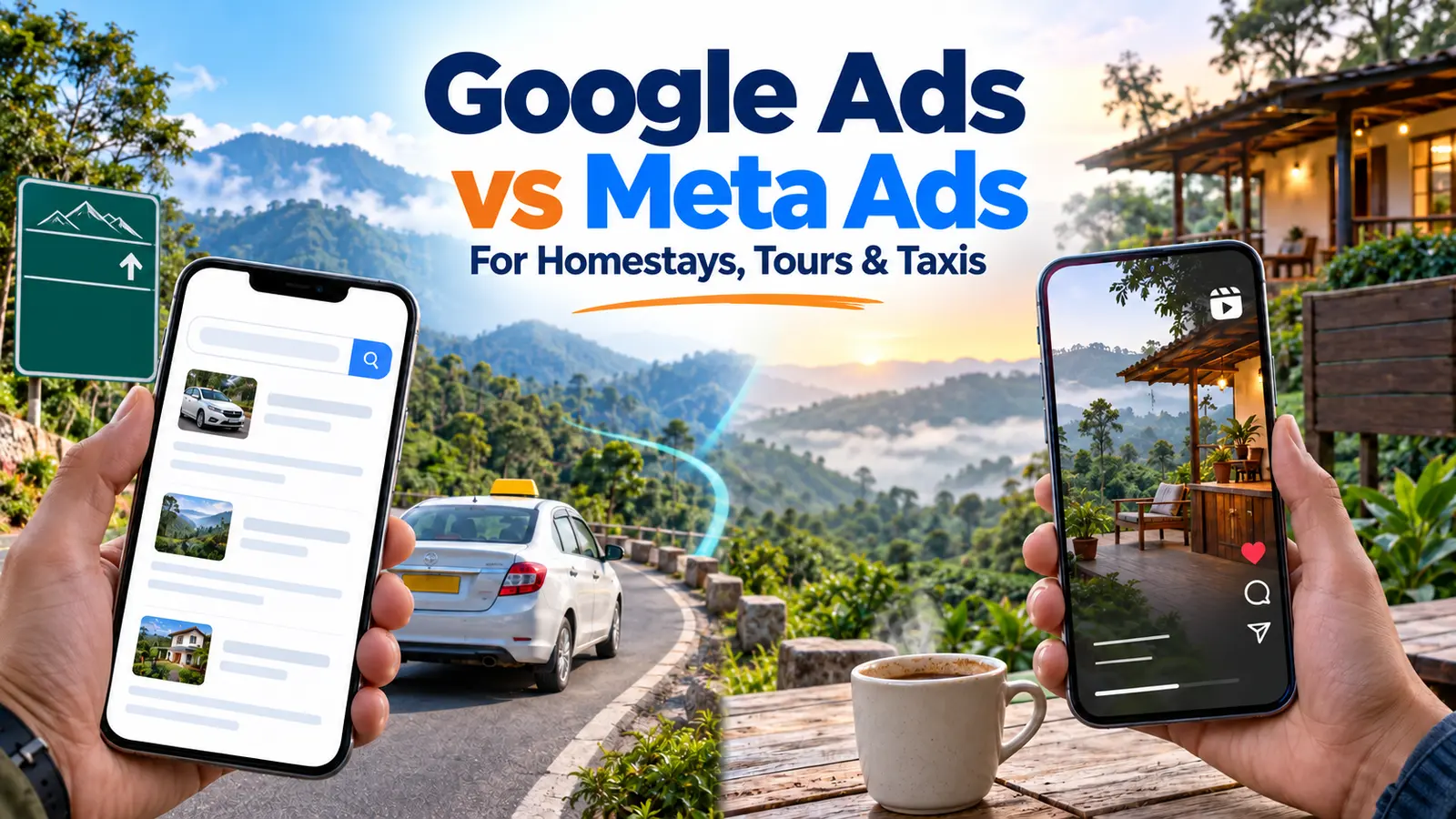
Google Ads vs Meta Ads for Tourism Businesses: Which Works Better?
For homestays, tour operators and taxi services, the right answer is rarely “Google” or “Meta” for every situation. The better platform depends on what the traveller is doing at that moment: searching with an immediate need, comparing options, or simply becoming inspired to take a trip.
Tourism businesses often compare Google Ads and Meta Ads as if both platforms perform the same job. They do not. Google Search Ads are designed to meet existing demand. Meta Ads on Facebook and Instagram are powerful for creating attention and shaping demand through images, Reels, stories and offers.
That difference matters. A traveller searching for an airport taxi tonight behaves very differently from someone watching a Reel about a misty Coorg homestay and considering a weekend getaway next month. The ad platform, creative, landing page and follow-up process should match that behaviour.
The Core Difference: Search Intent vs Travel Inspiration
Capture demand that already exists
Search campaigns place your offer in front of people typing relevant queries into Google. Google describes Search campaigns as a way to reach people actively searching for specific products or services.
The customer may already have a destination, date, route or accommodation type in mind. Your job is to be visible, relevant and easy to contact.
Create interest before the search begins
Facebook and Instagram ads appear while people explore feeds, Stories, Reels and Messenger. A strong visual can introduce a property, itinerary or destination even when the person was not actively planning a trip.
Your job is to stop the scroll, make the experience desirable and give the viewer a simple next step such as WhatsApp, a lead form or a landing page.
When Google Ads Is the Better Choice
Google Ads is strongest when the customer’s need is specific and time-sensitive. The search itself reveals intent. Queries containing a location, route, travel date, room type, price expectation or “near me” phrase can indicate that the customer is moving closer to a decision.
Taxi and cab services
Taxi customers often need a quick solution. Searches such as “airport taxi near me,” “Bangalore to Coorg cab,” “Coorg sightseeing taxi” or “Madikeri cab booking” are usually more valuable than broad travel-interest audiences because the person is already looking for transport.
A focused taxi Search campaign should normally include:
- Separate keyword groups for airport transfers, local sightseeing, outstation routes and one-way trips.
- Location targeting that matches the actual pickup area and service capacity.
- Call, WhatsApp and booking actions that work properly on mobile.
- Negative keywords that block irrelevant searches such as jobs, driver vacancies, free services or vehicle sales.
- Conversion tracking for qualified calls, WhatsApp enquiries and completed booking forms.
Homestays and hotels with active demand
Google Ads can also work well when travellers search for a specific destination or stay requirement, for example “family homestay in Coorg,” “homestay near Madikeri,” “pet-friendly stay” or “resort with mountain view.” In these cases, the landing page must confirm the promise made in the ad.
Show real room photographs, location, occupancy, important amenities, check-in details, nearby attractions, pricing guidance and a direct booking route. Sending every ad to a generic homepage usually creates unnecessary friction.
The main limitation of Google Ads
High-intent tourism searches attract competition from other local businesses and large online travel agencies. A small advertiser should not try to compete on every broad term. Start with profitable routes, specific destinations and services you can fulfil well. Relevance and a strong landing page are more useful than simply increasing the budget.
When Meta Ads Is the Better Choice
Meta Ads is especially useful when the experience itself is the selling point. Tourism is visual: room ambience, plantation views, waterfalls, local food, sunrise drives, family moments and well-planned itineraries can communicate value faster than a text-only offer.
Unique homestays and destination properties
A scenic or distinctive property can generate demand through short Reels, carousel ads and Stories. Instead of listing every facility, show the moments a guest wants to experience: waking up to a valley view, having coffee on the balcony, gathering around a fire or reaching nearby attractions easily.
The advertisement should still answer practical questions. Mention the destination, ideal guest type, key differentiator and next step. Beautiful footage without location or booking context may earn views but produce weak enquiries.
Tour packages and seasonal offers
Meta Ads can present an itinerary as a story. A short video can move from the starting city to the destination, show two or three major experiences and finish with duration, ideal audience and enquiry action. This works well for weekend getaways, honeymoon packages, family trips and seasonal travel.
Lead forms and messaging ads can reduce the effort required to enquire, but easy forms may also bring casual leads. Ask a few useful qualifying questions—travel date, number of guests, starting location and package duration—without making the form unnecessarily long.
The main limitation of Meta Ads
A person can enjoy a Reel without being ready to book. This means response speed and lead nurturing matter. A delayed or generic WhatsApp reply can waste an otherwise good campaign. Prepare package summaries, starting prices, availability questions and follow-up messages before launching the ads.
Google Ads vs Meta Ads: Quick Comparison
| Decision factor | Google Ads | Meta Ads |
|---|---|---|
| Customer mindset | “I need a taxi, stay or package and I am searching now.” | “This looks interesting; I may plan a trip.” |
| Primary strength | Capturing active, high-intent demand. | Creating attention and travel desire visually. |
| Best suited to | Urgent taxi needs, destination searches, specific stay requirements and last-minute availability. | Scenic homestays, curated packages, Reels, seasonal offers and new-brand discovery. |
| Typical response speed | Often faster because the user is already looking for a solution. | Often slower because interest may begin before firm travel plans. |
| Essential assets | Relevant keywords, clear ad copy, focused landing pages, phone and booking actions. | Strong Reels or images, a clear offer, lead qualification and fast WhatsApp follow-up. |
| Main risk | Expensive or wasted clicks from broad, competitive or irrelevant searches. | Cheap but low-intent leads that require more follow-up. |
| What to measure | Qualified calls, booking enquiries, confirmed bookings and cost per booking. | Qualified conversations, lead-to-booking rate, confirmed bookings and creative performance. |
Which Platform Should Each Tourism Business Start With?
Taxi or cab operator
Start with Google Search Ads. Prioritise profitable routes, airport transfers and destination-specific searches. Meta can later support brand awareness, sightseeing videos and remarketing.
Homestay or boutique property
Choose based on the property’s advantage. Use Meta first when the stay is highly visual and needs discovery. Use Google first when there is strong destination search demand and your website can compete clearly on location, rooms and trust.
Tour package provider
Meta is often the stronger starting point for curated packages. It can introduce the itinerary and experience. Add Google Search campaigns for people actively looking for specific destination packages, durations or departure cities.
What If the Monthly Budget Is Limited?
Splitting a small budget across too many campaigns can prevent either platform from collecting enough useful data. If the budget is tight, choose one primary objective and one customer segment.
- Urgent service with clear search demand: start with a narrowly targeted Google Search campaign.
- Visually distinctive experience: start with one or two strong Meta creatives and a simple enquiry route.
- No reliable website or follow-up process: fix the customer journey before increasing ad spend.
- Multiple destinations or services: begin with the most profitable and easiest-to-fulfil offer rather than advertising everything.
Give the campaign enough time and budget to produce meaningful enquiries, but review search terms, lead quality and response handling throughout the test. Do not judge success only by click-through rate or the number of form submissions.
The Ideal Strategy: Use Both as One Booking Funnel
When the business has sufficient budget, strong creative and a reliable follow-up system, Google and Meta can support different stages of the same journey.
Build interest with visual storytelling
Use Meta Reels, Stories or carousel ads to introduce the destination, property or itinerary to suitable audiences.
Capture early enquiries
Send interested travellers to WhatsApp, a short lead form or a useful package page. Collect dates, group size and travel needs.
Stay visible during comparison
Use remarketing carefully so previous visitors and engaged viewers remember the business while considering alternatives.
Capture high-intent searches
Use Google Search Ads for travellers actively searching for the destination, property type, package duration or taxi route.
Convert with a clear booking experience
Use a fast mobile page, transparent information, genuine photos, trust signals and simple call or WhatsApp actions.
Measure Bookings, Not Vanity Metrics
The cheapest lead is not always the best lead, and the platform with the most clicks is not automatically the winner. Tourism businesses should connect advertising data with actual sales conversations.
Track:
- Cost per qualified enquiry.
- Percentage of enquiries with a real date, group size and destination.
- Lead-to-confirmed-booking conversion rate.
- Cost per confirmed booking.
- Booking value and revenue attributed to advertising.
- Missed calls, response time and reasons enquiries did not convert.
A campaign may appear expensive at the click level but still be profitable if it produces high-value bookings. Another campaign may produce many inexpensive WhatsApp messages but little revenue. Your sales records must complete the picture that the advertising dashboard starts.
Common Mistakes That Waste Tourism Advertising Budgets
- Advertising every service, destination and audience in one campaign.
- Sending paid traffic to a slow or confusing homepage.
- Using generic stock visuals that do not represent the real property or experience.
- Hiding price expectations, location or important booking conditions.
- Ignoring negative keywords in Google Ads.
- Running the same Meta creative for months without testing new openings or angles.
- Replying slowly to calls, forms or WhatsApp enquiries.
- Counting every message as a lead without checking quality.
- Making exaggerated claims that the website or team cannot support.
Frequently Asked Questions
Is Google Ads better than Facebook and Instagram Ads for tourism?
Not universally. Google Search Ads are generally better at capturing existing demand, while Facebook and Instagram ads are better at creating awareness and inspiration. The right choice depends on the service and the traveller’s buying stage.
Which ads are best for a taxi business?
Google Search Ads are usually the best starting point because taxi customers commonly search with a specific route, destination or immediate requirement. Strong location targeting, call actions and negative keywords are essential.
Which ads are best for a homestay?
Meta Ads can work especially well for scenic or distinctive properties because Reels and images showcase the experience. Google Ads can capture travellers already searching for a stay in that destination. Many properties benefit from using both at different funnel stages.
Are Meta leads lower quality?
Meta leads can have lower immediate intent because users were not necessarily searching to book. Better creative, transparent offers, qualifying questions and fast follow-up can improve lead quality significantly.
Should ads send people to WhatsApp or a website?
Use the route that helps the customer make a confident decision. WhatsApp is convenient for quick conversations, while a focused landing page can explain rooms, routes, itineraries, inclusions and policies before the enquiry. In many cases, the best landing page ends with a clear WhatsApp or call action.
How should a tourism business choose an advertising budget?
Start from the value of a confirmed booking, expected margins, available inventory and the number of enquiries the team can handle. Test a focused campaign before expanding into more services, audiences or platforms.
Final Recommendation
Do not choose an advertising platform because it is popular or because another tourism business uses it. Choose it based on customer intent.
For urgent taxi and route-based enquiries, start with Google Search Ads. For visually attractive homestays and curated tour packages, Meta Ads can be the stronger discovery channel. For a complete growth strategy, use Meta to create interest and Google to capture customers when they are ready to act.
The website, offer and follow-up system remain just as important as the platform. Advertising can create traffic and enquiries, but clear information, genuine trust and fast responses are what turn those enquiries into bookings.
Need a practical advertising plan for your tourism business?
eAppsi helps homestays, tour operators and taxi businesses plan Google Ads, Meta Ads, landing pages and conversion tracking around qualified enquiries and direct bookings.
Google Ads Management
Meta Ads Management
Discuss Your Campaign